Read below to find out how to pass the **Save America Act**
There is a realistic constitutional route to passing the full SAVE America Act with approximately 50 senators plus the Vice President, but it requires the Senate itself to change the precedent governing legislative cloture.
The President cannot do it alone. The Vice President cannot do it alone.
But a sufficiently unified Senate majority can.
And because of an unusual feature of the bill's history, the House has already done most of the work.
Where the bill actually stands
The operative legislative vehicle is S.1383.
Originally, S.1383 was a veterans bill that the Senate passed unanimously on December 18, 2025. The House subsequently struck everything after the enacting clause and substituted the SAVE America Act, passing that amendment 218–213 on February 11, 2026.
That is extremely important procedurally.
The Senate does not need to originate another SAVE bill. If the Senate simply concurs in the House amendment to S.1383 without changing it, both Houses will have approved exactly the same legislative text and it can go directly to the President. Article I, Section 7 then permits the President to sign it into law.
The Senate already voted 51–48 on March 17 to proceed to the House message. The problem has been ending debate. On March 26, for example, cloture on a voter-ID amendment failed 53–47 because 53 is still short of the ordinary 60-vote cloture requirement.
As of today, August 8, AP reports that the Senate has now adjourned for its August state-work period, that the SAVE America Act still lacks sufficient Republican support to pass under the strategies currently being considered, and that senators are considering another budget/reconciliation attempt in September.
The most direct constitutional route
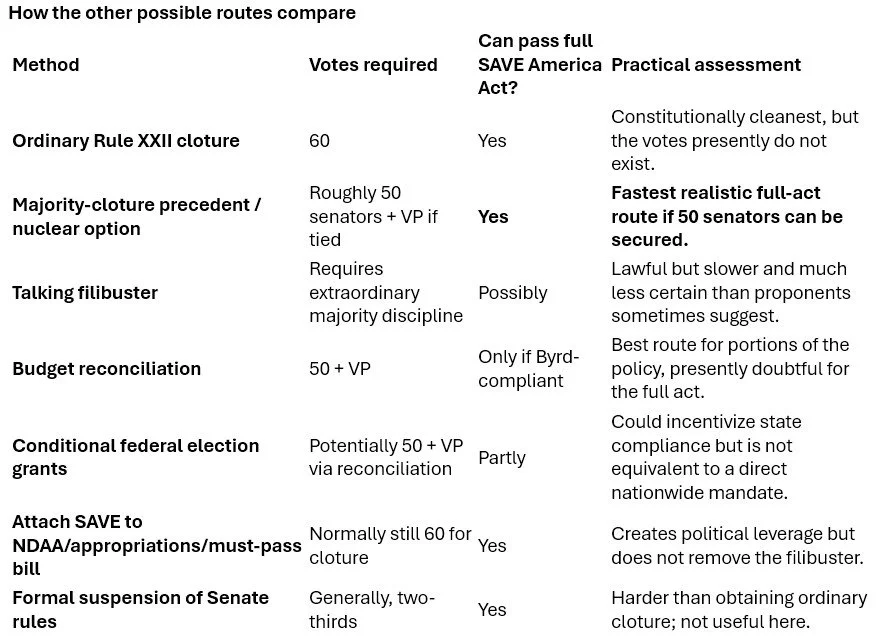
If the objective were to pass the full House version as quickly as constitutionally possible, this is the route I would identify.
First, secure 50 committed senators before doing anything publicly procedural. This is the indispensable prerequisite. The Senate currently has 53 Republicans, 45 Democrats, and two independents who caucus with Democrats. If all 100 seats participate and all 47 Democratic-caucus senators oppose, 50 Republican senators plus the Vice President can prevail on an evenly divided 50–50 simple-majority question. Article I, Section 3 expressly makes the Vice President the President of the Senate and gives him a vote when the Senate is equally divided. The present obstacle is therefore not constitutional arithmetic—it is Republican unity. AP reported today that proponents do not presently have enough Republican support.
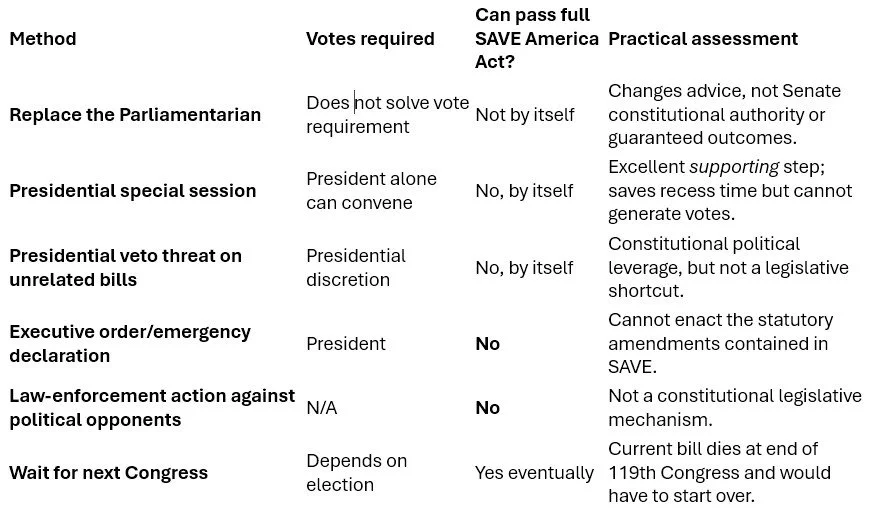
President Trump could immediately call the Senate back from recess. Article II, Section 3 says that on “extraordinary Occasions” the President may convene either House or both Houses of Congress. That is an actual constitutional presidential power—not a Senate custom. The Senate's published calendar currently designates August 10 through September 11 as a state-work period, so absent presidential action senators are not ordinarily expected back until after that period. Calling a special session would therefore potentially save about five weeks. The President cannot require them to vote a particular way, however.
Resume consideration of the House message to S.1383. There is no need to start over with H.R.7296 or S.3752. The House amendment to S.1383 already contains the SAVE America Act. On March 17, Thune successfully moved to lay that House message before the Senate, 51–48. For maximum efficiency, the objective should be concurrence in that House amendment without further substantive Senate amendment.
File cloture on the controlling question. Under current Rule XXII practice, ordinary legislation normally requires three-fifths of senators duly chosen and sworn—normally 60 votes—to invoke cloture. The cloture motion ordinarily ripens on the second day of Senate session after filing. CRS explains that legislation can otherwise be filibustered because the Senate has no ordinary “previous question” motion allowing a simple majority simply to terminate debate.
Allow the 60-vote cloture effort to fail if 60 votes still do not exist. This produces the parliamentary setting for the next move. Historically that is how the Senate created its majority-cloture precedents for nominations.
Use the Senate-precedent or “nuclear option” procedure to establish majority cloture for legislation—or, more narrowly, for this category of legislation. This is the pivotal step. A senator would raise a point of order asserting that cloture on the relevant legislative question is obtainable by a numerical majority. Under existing Rule XXII precedent, the presiding officer would ordinarily reject that interpretation. The ruling is then appealed to the Senate. The Senate itself is the ultimate authority over interpretation of its procedural rules under Article I, Section 5, which provides that “Each House may determine the Rules of its Proceedings.”
There is direct precedent for this mechanism. In 2013 the Senate overturned the chair and thereby reduced cloture to a majority for most nominations. In 2017, Majority Leader Mitch McConnell raised a point of order seeking majority cloture for Supreme Court nominations. The chair rejected it; McConnell appealed; the Senate voted 48–52 against allowing the chair's ruling to stand, thereby establishing the new majority-vote precedent. The Senate immediately reconsidered cloture and invoked it by simple majority.
That precedent currently applies to nominations, not legislation. Extending it to legislation would be an enormous institutional change, but the procedural architecture already exists.
The Vice President could preside during that proceeding, but he could not accomplish it by decree. This is an important distinction. Vice President Vance could occupy the chair and make the ruling on the point of order. He could even rule in favor of the majority's proposed interpretation rather than accepting the Parliamentarian's recommendation. But the opposition could appeal his ruling. At that point, the Senate determines whether the ruling stands. CRS states explicitly that the Senate itself is the final authority on interpretation and application of its rules. So the VP can be strategically important, particularly in a 50–50 vote, but cannot substitute for approximately 50 senators.
Immediately re-vote cloture under the new precedent. That is precisely what happened after the 2017 nuclear-option precedent. Once the Senate established that majority cloture applied, it reconsidered the failed cloture motion and invoked cloture under the new threshold. With 50 senators plus the Vice President, the SAVE America Act could therefore move into post-cloture consideration even without 60 senators.
Run out or negotiate away the post-cloture time. Under ordinary legislative cloture, up to 30 hours of additional consideration may remain. Cloture also severely restricts amendments and dilatory tactics. The fastest clean approach would be a unanimous-consent agreement shortening that time, although opponents obviously could refuse. Otherwise, the majority simply remains in session and consumes the available time. A second nuclear-option maneuver could theoretically change post-cloture procedure, but that would add unnecessary institutional risk when waiting roughly 30 hours accomplishes the same result.
Vote to concur in the House amendment to S.1383 exactly as transmitted by the House. This is where avoiding amendments matters. A simple majority decides ordinary final passage/concurrence once debate has ended. If the result is 50–50, the Vice President can cast the deciding vote under Article I, Section 3. If instead the Senate changes the House language, the amended bill must return to the House, creating another opportunity for delay or defeat.
Send the enrolled legislation directly to President Trump. Because the Senate would have concurred in precisely the House-passed amendment, there is no conference committee and no additional House vote. Article I, Section 7 requires passage by both Houses and presentment to the President. He signs it, and it becomes law.
Why I think that is the fastest complete route
· It takes advantage of four things already in place:
· The House has already passed the operative text.
· The Senate has already demonstrated majority support for taking up the House message.
· The Constitution expressly gives the Senate authority over its own proceedings.
· There is an established Senate precedent for changing the cloture threshold through an appeal of the chair rather than formally rewriting Rule XXII.
· CRS describes the 2013 and 2017 procedures as unusual and controversial but confirms that a simple Senate majority established new procedural precedent by overturning the chair.
· It would be a profound change to Senate practice. But it is qualitatively different from the President simply ignoring the Senate rules: the Senate itself would be making the change under its Article I rulemaking authority.
T
The talking-filibuster option deserves special caution
The popular description is: “Make opponents actually talk until they become exhausted; then vote.”
Senate procedure is considerably messier.
Rule XIX contains a two-speech rule: a senator may speak twice on the same question during the same legislative day. The majority could keep the same legislative day alive by recessing rather than adjourning, theoretically forcing opponents eventually to consume their speeches.
But CRS explains the problem: amendments, motions and other parliamentary questions can create new debatable questions, giving senators additional speaking opportunities. Therefore, a determined minority can potentially prolong the fight far beyond merely putting 47 senators at a microphone one after another.
The majority would also need nearly perfect attendance and discipline for quorum calls, motions to table, procedural votes and continuous sessions. That is why I rank it below the nuclear-option route for efficiency.
Reconciliation is real—but it has a serious limitation
Reconciliation normally has enormous appeal here because debate is statutorily limited and cloture is unnecessary, allowing a reconciliation bill to reach final passage by majority vote.
But the Byrd Rule prohibits “extraneous” provisions, including provisions whose budget effects are merely incidental to their nonbudgetary policy effects. Waiving the Byrd Rule normally requires 60 senators.
The full SAVE America Act's core provisions—citizenship documentation, voter identification and election administration mandates—are overwhelmingly regulatory rather than primarily fiscal. The Parliamentarian has reportedly already rejected attempts to place major SAVE provisions into reconciliation on that basis. Republicans are therefore now exploring a different approach: federal election grants tied to state adoption of SAVE-type measures. The House's July 22 budget framework allocates $10 billion toward election-related measures as part of a broader $95 billion package.
That may prove much more Byrd-compatible because money actually moves.
But Rep. Chip Roy himself has pointed out the drawback: an optional financial incentive to states is not the same thing as the mandatory nationwide SAVE America Act.
So, reconciliation may be the best route to part of the policy, but not necessarily the best route to the actual House-passed act.
What about simply firing the Parliamentarian?
That does not solve the underlying problem.
The Parliamentarian advises the presiding officer; she does not possess constitutional veto power over legislation. The Senate ultimately interprets its own rules.
Replacing the Parliamentarian with someone who interpreted the Byrd Rule differently could change the advice given to the chair, but it would not prevent another senator from raising a Byrd Rule point of order. Under existing law, overcoming an adverse Byrd Rule ruling generally requires three-fifths.
If the majority is prepared to overturn established Senate procedure, anyway, changing the legislative cloture precedent directly is cleaner and more transparent than firing an official in hopes of obtaining a different interpretation.
What the President can constitutionally contribute
President Trump actually has several significant tools, just none that amount to legislative command.
He can convene the Senate immediately under Article II, Section 3.
He can recommend the legislation and exert political pressure.
He can negotiate commitments from Republican senators.
He can announce that he will veto unrelated legislation presented to him, exercising his Article I veto power, unless Congress acts on SAVE. That's political leverage rather than a procedural override.
And once the identical legislation passes both Houses, he can sign it immediately.
What he cannot do is declare that the House vote plus presidential approval substitutes for Senate passage. Article I, Section 7 expressly requires passage through both Houses.
What the Vice President can constitutionally contribute
The VP's strongest role would be during the nuclear-option proceeding.
He could personally preside.
He could rule on the point of order.
He could decline to follow the Parliamentarian's recommendation.
He could rule that the majority-vote interpretation applies.
And, if the Senate divided 50–50 on the resulting appeal or final legislative question, he could cast the deciding vote. But every one of those routes ultimately depends upon approximately 50 senators supporting the procedural change and the legislation. Article I deliberately makes the VP President of the Senate while withholding an ordinary vote except when senators themselves are equally divided.
This is worth distinguishing from the Senate-procedure question.
Article I, Section 4—the Elections Clause—allows Congress to make or alter state regulations governing the “Times, Places and Manner” of congressional elections. The Supreme Court has interpreted that authority broadly enough to encompass registration, supervision of voting, prevention of fraud, counting, and other election machinery.
In Arizona v. Inter-Tribal Council, the Supreme Court specifically held that federal voter-registration rules under the National Voter Registration Act displaced contrary Arizona registration requirements.
That does not mean every provision of SAVE is automatically immune from constitutional litigation; voting qualifications and election procedures are constitutionally distinct subjects. But there is a substantial textual constitutional basis for Congress regulating the machinery of federal elections.
The shortest version of the strategyIf the objective is the actual full House-passed SAVE America Act, rather than a diluted reconciliation substitute, I would rank this strategy first:
Get 50 Republican senators firmly committed → President calls the Senate into extraordinary session → resume S.1383 → file cloture → invoke the Senate precedent/nuclear procedure to establish majority cloture for legislation → VP participates and breaks a tie if necessary → invoke cloture with the new threshold → exhaust post-cloture time → Senate concurs in the existing House amendment without changing one word → President signs it.
The single biggest obstacle is not the Constitution.
It is obtaining approximately 50 senators willing both to pass SAVE and to establish a newlegislative-filibuster precedent.
As of August 8, 2026, that coalition does not yet exist. AP reports that even proponents acknowledged overnight that they currently lack the votes, and leadership is instead looking toward a September budget/reconciliation strategy.
That means the real decision point is to persuade enough Republican senators to accept the majority-cloture precedent or accept a narrower reconciliation version of SAVE. Procedurally, everything downstream becomes much easier once that first decision is made.